
Questions this page answers
- 1.Where can a pool home rent by the night in Tampa Bay?
- 2.How do you check which rules apply to an address?
- 3.What does a pool change for a vacation rental?
- 4.Tampa Bay pool-home market snapshot (fall 2026)
- 5.What should you check before buying a pool home to Airbnb?
- 6.What do buyers want from a seller of a pool-home rental?
- 7.How investors should run the numbers
- 8.Frequently asked questions
…and 2 more sections below.
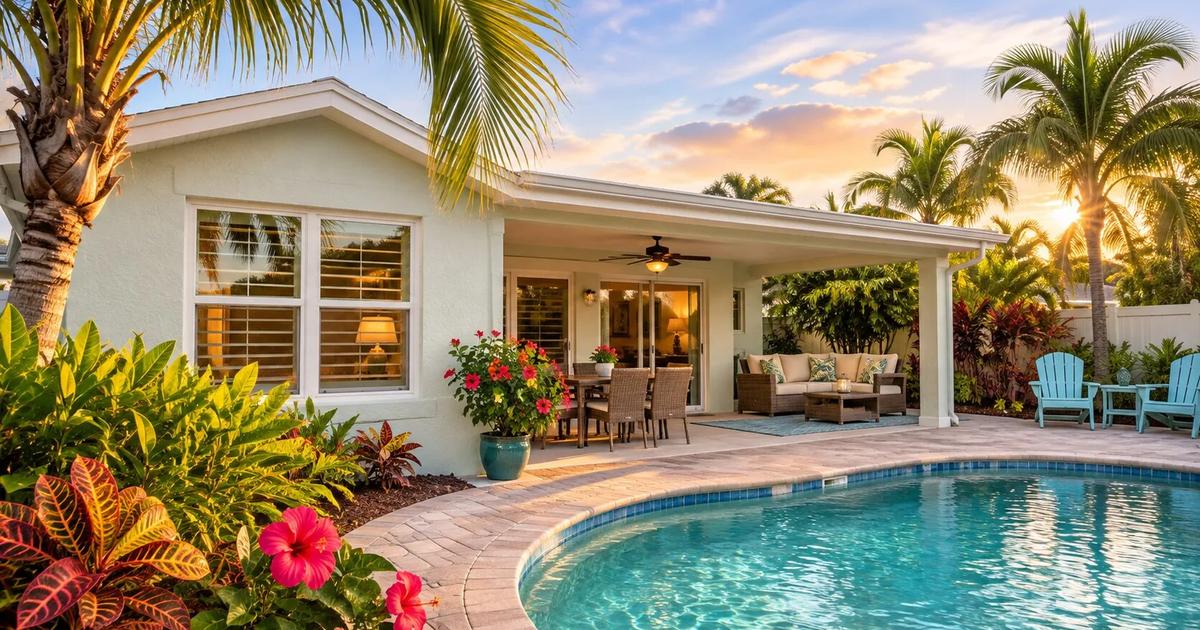
Photo: an illustrative Florida vacation rental with a private pool. It is not a listing or a specific property for sale.
Can you Airbnb a pool home in Tampa Bay? Yes, but only in some places, and the city line matters more than the pool. In most Pinellas cities a house in residential zoning can't take nightly guests. Unincorporated Pinellas County and Largo allow it with a permit, and in the City of Tampa and unincorporated Hillsborough County the floor for an ordinary home is a week.
The pool doesn't need its own rental license. It does add a safety inspection in some places, an insurance question and a real line in your operating budget. Below is how I'd screen a pool home before you buy it, how to price it if you own one now, and what buyers will ask for when you sell.
I'm Troy Nowak, Broker of Mangrove Bay Realty (BK3436609). I'm an Airbnb Superhost, I own and manage six short-term and furnished rentals, and I've closed 325+ sales. If you already have an address in mind, send it to me and I'll tell you which rules control it.
Where can a pool home rent by the night in Tampa Bay?
Only where the government on that parcel allows short stays. Here is how the main Tampa Bay jurisdictions treat a typical single-family home in residential zoning. Each row links the official source, and each city has more detail than a table can hold.
| Where the parcel sits | Shortest stay on a typical house | Nightly path | Source |
|---|---|---|---|
| Unincorporated Pinellas County | Nightly allowed with a permit | County Certificate of Use if you rent for under 30 days more than 3 times a year | Pinellas County STR program |
| City of Largo | Nightly allowed with a permit | City registration and inspections if you rent for 30 days or less more than 3 times a year | City of Largo |
| City of St. Petersburg | Under 30 days only 3 times in any 365 days | Only on property zoned and licensed for transient lodging | St. Pete transient accommodation handout |
| City of Clearwater | 31 days or one calendar month, whichever is less | Tourist zoning, an approved lodging use or documented grandfathered use | Clearwater Code Sec. 8-102 |
| City of Dunedin | 90 days or three calendar months | Only in districts the city lists, such as Tourist Facility and parts of Downtown Core, with city registration | City of Dunedin zoning page |
| City of Seminole | Under one month, more than 3 times in 12 months, is a temporary lodging use | The code lists that use in commercial and industrial districts, not residential ones | Seminole Code Sec. 70-2 |
| City of Tampa | A week or longer in single-family zoning | Only where a lodging use is approved for the parcel | 2022 Thirteenth Circuit appellate opinion |
| Unincorporated Hillsborough County | A week or longer in residential zoning | Only where a lodging use is approved; county registration starts January 1, 2027 | Hillsborough County meeting recap |
Rules last checked November 9, 2026. A few notes on the rows that trip people up:
- Largo treats a home as a short-term rental when it's rented more than three times a calendar year for stays of 30 days or less. Guests are capped at one per 150 square feet of air-conditioned space, with one off-street parking space per three guests. My Largo Airbnb rules guide walks through the registration.
- Unincorporated Pinellas caps a home at two guests per bedroom plus two more, with a maximum of 10, and one off-street space per three guests. The unincorporated Pinellas Airbnb rules guide has the fees and the full posting list.
- St. Pete isn't a nightly market for most houses. The St. Pete and Gulfport rules guide explains the three-stay limit.
- Clearwater, including Clearwater Beach, follows the 31-day rule on residentially zoned land. The Clearwater short-term rental guide covers the exceptions.
- Dunedin names the residential districts where short stays are prohibited, including every single-family district from R-60 to R-300. See the Dunedin Airbnb investment page for that market.
- Seminole has no short-term rental permit that I could find. Its Residential Low district lists single-family homes, accessory dwelling units and home occupations as the permitted uses. Ask the city for a written answer on the parcel before you count on nightly income.
- Tampa and unincorporated Hillsborough both use a weekly-or-longer standard for ordinary homes. The 2022 appellate opinion upheld a city ruling that stays under seven days in RS-60 single-family zoning violated Tampa's code. Our Tampa vs. unincorporated Hillsborough rules guide covers the county's new registration, which carries a $200 annual fee per unit.
Florida law limits what a city or county can do here. Under section 509.032(7)(b), a local rule may not prohibit vacation rentals or regulate how long or how often they're rented, unless it was adopted on or before June 1, 2011. That's why older rules like Clearwater's still apply, and why a new city can't simply ban short stays. It doesn't stop zoning and registration programs from shaping where and how you rent.
Other Pinellas towns, including Indian Rocks Beach and Pinellas Park, have their own rules. The Pinellas short-term rental map lists every city.
How do you check which rules apply to an address?
Look up the parcel, not the mailing address. A mailing city follows postal routes, so a "Clearwater" or "Seminole" address can sit in unincorporated Pinellas, and a "Tampa" address can sit in unincorporated Hillsborough.
- Pull the parcel record. Use the Pinellas County Property Appraiser or the Hillsborough County Property Appraiser and read the taxing district.
- Find the zoning district. For a Tampa parcel, the city's interactive zoning maps show it. Other cities have their own GIS maps.
- Get the answer in writing. Email the city or county planning office and ask whether stays under 30 days (or under a week, in Hillsborough) are allowed on that parcel. Keep the reply in your closing file.
- Read the private rules. An HOA or deed restriction can be stricter than the city. It can't make an illegal use legal.
What does a pool change for a vacation rental?
Mostly safety, insurance and cost. A private pool at a single-family home doesn't need a separate rental license, but the places that inspect short-term rentals look at it.
Safety. Pinellas County's Certificate of Use inspection checks that a property with a pool meets the Residential Swimming Pool Safety Act (county FAQ, question 11). Largo's short-term rental requirements show a pool barrier fence and a sliding door alarm. Under Florida Statutes 515.27, a residential pool meets the act with at least one of these:
- A barrier that isolates the pool from the house.
- An approved safety pool cover.
- An exit alarm on every door and window that opens straight to the pool.
- Self-closing, self-latching doors to the pool, with the release at least 54 inches above the floor.
- A pool alarm certified to ASTM F2208.
Before you close, walk the pool area with that list. If the house has open sliders to the pool and no alarms, budget for the fix before your first guest.
Insurance. Get a written quote that names the rental use. Ask the agent how the policy treats the pool, any slide or diving board, and guest injuries. A homeowner policy written for a primary residence may not fit nightly guests.
Operating cost. Weekly pool service, chemicals, equipment repairs and the power or gas bill for a heater all belong in your numbers. If you plan to advertise a heated pool, price the heater and what it costs to run it in January before you count on winter bookings.
Guest count. A pool makes a home attractive to bigger groups, but the local cap decides how many can stay. In unincorporated Pinellas the cap is 10. In Largo it follows the air-conditioned square footage and the parking.
Tampa Bay pool-home market snapshot (fall 2026)
Single-family homes in Pinellas are selling faster than a year ago, at higher prices. These numbers come from the September 2026 Pinellas County report produced by Florida Realtors with data from Florida's multiple listing services (local market statistics).
| Pinellas single-family, September 2026 | Figure | Change from September 2025 |
|---|---|---|
| Median sale price | $465,000 | Up 9.4% |
| Closed sales | 746 | Down 9.0% |
| Median time to contract | 36 days | Down 14.3% |
| Months' supply of inventory | 3.7 | Down 11.9% |
| Median percent of original list price received | 94.7% | Up 1.7% |
Source: Pinellas County monthly statistics, September 2026, released October 16, 2026.
On the visitor side, Visit St. Pete/Clearwater reported 14.9 million visitors to Pinellas in fiscal year 2025 and more than $92 million in tourist development tax. Its visitor profile put the average travel party at 3.6 people and the average stay in paid lodging at 4.1 nights (December 2025 destination metrics).
What I take from that: four-night trips by groups are exactly what a pool home is built for, and they fall well under the 30-day line. That's why the legal stay on the parcel matters so much. A house that can only rent monthly is a different business, even with the same pool.
What should you check before buying a pool home to Airbnb?
Work in this order. Each step can end the deal before you spend money on the next one.
- Government. City or unincorporated county? Use the property appraiser, not the listing.
- Legal stay. What's the shortest stay allowed on that zoning? Get it in writing.
- Permit path. County Certificate of Use, city registration or none? Plan to apply in your own name. In unincorporated Pinellas the certificate doesn't transfer, and a new owner must apply within 30 days of buying (county FAQ).
- Guest and parking math. Count real bedrooms and real off-street spaces. Underwrite the legal guest count, not the beds that fit.
- Pool safety. Check the barrier, alarms and door latches against the list above.
- State license. Florida DBPR requires a vacation rental license if you rent a home more than three times a calendar year for less than 30 days or one calendar month, whichever is less, or advertise it as regularly rented. A house takes a Vacation Rental Dwelling license (DBPR vacation rental guide). Licenses don't transfer between owners (Fla. Stat. 509.241).
- Taxes. Stays of six months or less carry state sales tax, the county surtax and the county tourist development tax:
| County | State sales tax | County surtax | Tourist development tax | Total |
|---|---|---|---|---|
| Pinellas | 6% | 1% | 6% | 13% |
| Hillsborough | 6% | 1.5% | 6% | 13.5% |
Sources: Fla. Stat. 212.03 for the 6% rate and the six-month rule, the 2026 DR-15DSS surtax rates, the DR-15TDT tourist tax rates, Pinellas County tourist development tax and the Hillsborough County Tax Collector. Our Pinellas Airbnb taxes guide explains what the platforms collect for you.
- Insurance and financing. Get written quotes before your inspection period ends, and pick a loan that allows the rental use. Read how to finance a short-term rental in Pinellas early.
- Fallback plan. Price the house as a furnished monthly rental and as a yearly rental. If neither works, nightly income rarely saves the deal.
If you're buying a pool home that already rents, read what transfers when you buy an operating Airbnb too.
What do buyers want from a seller of a pool-home rental?
Proof that the rental is legal, that the numbers are real and that the pool won't surprise them. Pool-home buyers in this market ask the same questions I ask on the buy side, so have the answers in one folder before you list:
- The government and zoning for the parcel, and any written answer you got from the city or county.
- Your Certificate of Use or city registration, with inspection reports. Tell buyers plainly that permits and the state license don't move with the deed.
- Twelve to 24 months of booking statements and the matching tax filings.
- Pool equipment ages, service records, any permits for pool work and the safety features in place.
- Your insurance declarations page and claims history.
- HOA or deed restrictions on rentals, if any.
Gaps in that folder slow a sale down. My guide to selling an Airbnb in Pinellas County lists the full package. If you're still deciding whether to sell at all, start with sell or keep your Pinellas vacation rental.
How investors should run the numbers
Start from the stay length the parcel allows, then subtract everything a listing page leaves out.
- Use the legal calendar. If a seller's income came from stays the city doesn't allow, it isn't income you can buy.
- Count the fixed costs. Permits and inspections (Pinellas County lists a $450 Certificate of Use fee, a $150 inspection and a $450 annual renewal; Largo lists its annual fire inspection at $100), the DBPR license, insurance, utilities, pool service, cleaning, platform fees and the taxes above.
- Model three versions. Nightly, furnished monthly and yearly. Compare them on cash flow, not gross revenue.
- Check the guest cap against the bedrooms. A five-bedroom home in unincorporated Pinellas still tops out at 10 guests.
Our cost to own a short-term rental in Pinellas guide lays out the expense lines, and the Tampa vs. St. Petersburg investing comparison helps if you're choosing a side of the bay. If you'd rather hand off the day-to-day, see short-term rental management.
Frequently asked questions
Can I Airbnb a pool home in Clearwater?
Only on some parcels. On residentially zoned land inside the City of Clearwater, rentals must run at least 31 days or one calendar month, whichever is less. Nightly stays need Tourist zoning, an approved lodging use or documented grandfathered use. A home with a Clearwater mailing address that sits in unincorporated Pinellas follows the county Certificate of Use program instead.
Do I need a special permit for the pool at a Pinellas vacation rental?
Not a separate pool permit for renting, but the pool gets checked. In unincorporated Pinellas, the Certificate of Use inspection confirms the pool meets the Residential Swimming Pool Safety Act. Largo's short-term rental requirements also show a pool barrier and a sliding door alarm.
Will renting my pool home affect my homestead exemption?
It can. Pinellas County's FAQ says you lose your homestead exemption if you rent the property for more than 30 days per calendar year for two consecutive years. Ask the Property Appraiser and your CPA before you list your own home.
Does a short-term rental permit transfer when I buy a house?
No. In unincorporated Pinellas the Certificate of Use is non-transferable, and the new owner must apply within 30 days of buying. The state vacation rental license doesn't transfer either, so plan to apply in your own name.
Who can help me buy or sell a pool-home vacation rental in Tampa Bay?
Troy Nowak, Broker of Mangrove Bay Realty (BK3436609) in St. Petersburg. He's an Airbnb Superhost who owns and manages six short-term and furnished rentals, and he has closed 325+ sales. He checks the parcel's rules, guest cap, pool safety and permit path before you make an offer or list. Reach him through the contact form.
Thinking about buying or selling a pool home rental?
Send me the address and how you plan to use it. I'll tell you which government controls it, the shortest stay it allows, the guest and parking math, and what to ask the seller or prepare as the seller before anyone signs. Start here.
Sources
All links were opened and checked on November 9, 2026. Some city sites block automated checks; those pages were read in a browser.
- Pinellas County STR Certificate of Use program and Certificate of Use FAQs
- City of Largo short-term vacation rentals
- City of St. Petersburg transient accommodation handout
- Clearwater Community Development Code Sec. 8-102
- City of Dunedin zoning and short-term rental information
- City of Seminole Land Development Code Sec. 70-2, definitions and Residential Low district
- Thirteenth Judicial Circuit appellate opinion, 2022 and City of Tampa zoning maps
- Hillsborough County Board meeting recap, September 2, 2026
- Florida Statutes 509.032, 509.241, 515.27 and 212.03, 2026 editions
- DBPR vacation rental licensing guide
- Florida Department of Revenue DR-15DSS and DR-15TDT
- Pinellas County tourist development tax and Hillsborough County Tax Collector, tourist development tax
- Pinellas County Property Appraiser and Hillsborough County Property Appraiser
- Pinellas County monthly market statistics, September 2026, produced by Florida Realtors
- Visit St. Pete/Clearwater destination metrics, December 2025
This page is general real estate education, not legal, tax or insurance advice. Zoning, licensing, tax rates and association rules change, and only the city or county can confirm what a parcel allows. Before you buy, sell or rent, confirm the rules for the exact address with the local government, Florida DBPR, the county tax collector and your own attorney, CPA and insurance agent. Facts on this page were checked November 9, 2026.
The photo at the top of this page is an illustration of a Florida vacation rental. It doesn't show a property for sale, and nothing on this page describes that home's location, price or rental income.