
Last verified: November 25, 2026
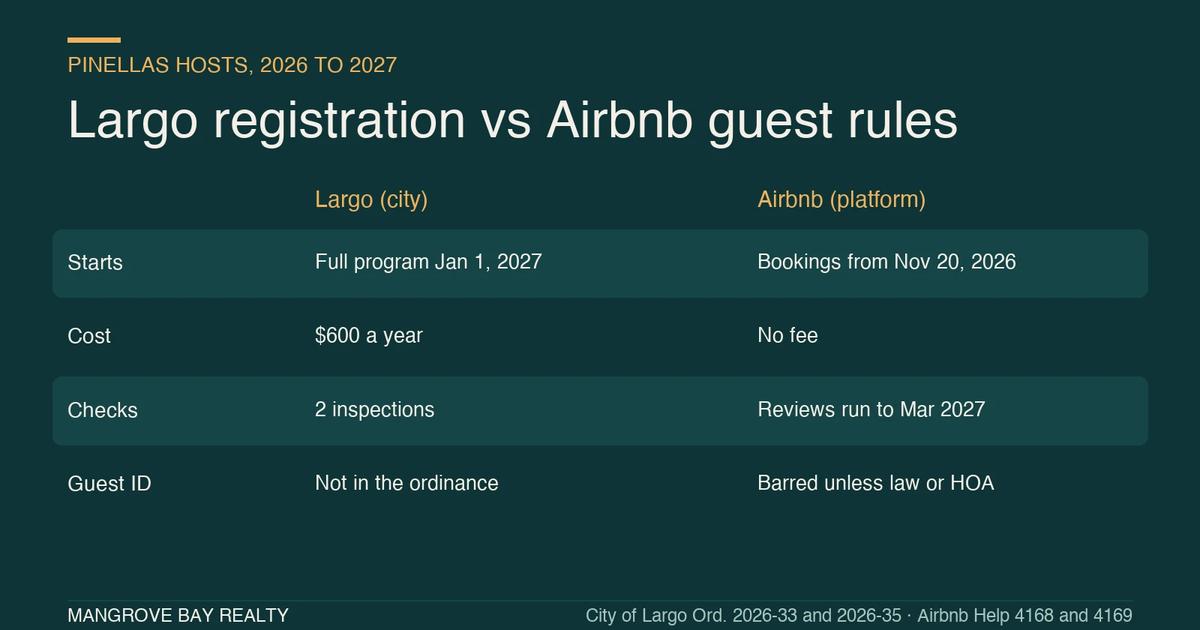
Quick answer: If you rent a place in Largo, you now need a yearly city registration ($600) and two inspections before the full program starts on January 1, 2027. If you list on Airbnb anywhere in Pinellas, bookings made on or after November 20, 2026 fall under new Airbnb rules that bar you from collecting guest ID, phone numbers, home addresses and background checks, unless a law or a documented HOA rule requires it. The two rules don't conflict. They are two separate checklists, and this post puts them side by side.
I'm Troy Nowak, Broker of Mangrove Bay Realty (BK3436609). For the full detail on each rule, see my Largo Airbnb rules guide and my post on Airbnb's new host rules.
What did Largo change for short-term rentals?
Largo's city commission gave final approval to Ordinance 2026-33 on October 6, 2026, according to WUSF's report. The ordinance rewrites Section 15.18 of the city's Comprehensive Development Code. A companion fee ordinance (2026-35) and a chronic nuisance ordinance (2026-34) came up at the same meeting.
Here is what the ordinance text in the city's agenda packet says:
| Topic | What Largo requires |
|---|---|
| Who is covered | A house, condo unit, duplex, triplex or fourplex rented to guests more than three times in a calendar year for stays of less than 30 days, or advertised as regularly rented. Timeshares are excluded |
| Certificate | One registration certificate per unit, valid for one year |
| Renewal | Apply at least 60 days before it expires |
| If you sell | The certificate does not transfer. The new owner must apply within 30 days |
| Fee | $600 to register and $600 to renew, per the fee ordinance. The city says the fee covers added staff, equipment and software |
| Inspections | A Community Standards compliance inspection and a Fire Rescue Life Safety inspection, before any guests and again at renewal |
The ordinance also sets the operating rules every registered rental has to meet:
- Occupancy: one person per 150 square feet of permitted, conditioned living space.
- Parking: one off-street space for every three guests. Street parking doesn't count. A garage counts if it is open and the guests can use it.
- Responsible party: someone reachable 24 hours a day who, or whose agent, can reach the unit within two hours if a problem can't be solved by phone. Their name and number must be posted on the front exterior where the public can see it, or registered through the Police Department's emergency decal system.
- Fire safety: a 2A:10B:C dry chemical fire extinguisher on each floor.
- Posted notice inside: the responsible party's contact, trash and recycling days, the nearest hospital, an evacuation statement and the city's noise rules.
- Pools and spas: they must meet Florida's Residential Swimming Pool Safety Act (Chapter 515).
- Your application: a copy of your state lodging license, a statement that you collect and pay tourist taxes, your maximum occupancy and bedroom count, the responsible party's contact and a parking plan.
The city's own fire inspection page lists a $100 charge for high-hazard annual inspections. The new ordinances don't mention it. Ask Largo Fire Rescue at 727-587-6714 whether it applies on top of the $600. Community Standards is at 727-587-6799.
When does Largo's registration start?
WUSF reports that the city will begin notifying owners and rolling out registration in November, with the full program starting January 1, 2027. I did not find a registration page or application portal on the city's website as of November 25. The ordinances take effect when adopted and I found no grace period written into the text. Call Community Standards before you assume you have until January.
The chronic nuisance ordinance applies to any property with repeated problems, not just rentals. Press coverage says it adds an abatement plan and special magistrate hearings. I could not find the text of that ordinance, so check it before you rely on the details.
What did Airbnb change for guest information?
Airbnb's Help Center article 4169 and article 4168 apply to every reservation booked on or after November 20, 2026. Under them, hosts may not collect:
- ID details or documents, such as a passport, driver's license, Social Security number or photo.
- Contact information, such as a phone number, home address or email address.
- Credit history or background check information.
Hosts also can't require a separate rental agreement, a third-party app or registration on another website, and they can't fine guests or add rules after booking. Airbnb's Resource Center page, updated November 3, says its initial listing reviews continue through March 2027. Hosts get notice and at least 20 days to fix a listing or appeal. Under article 4168, a rule that breaks the policy can lead to a notice on the listing, lower search visibility or other action.
There are three exceptions for collecting information:
- A law requires it.
- A documented community association rule requires it, such as an HOA or building security rule.
- It is needed for a contract Airbnb allows, such as an insurer's requirement or a stay of 28 nights or more.
If an exception applies, you have to say exactly what you collect, and why, in the listing's additional rules section so guests see it before they book. You can't collect more than the law or rule calls for, and you have to store it securely. Airbnb may ask for proof. You may also check a guest's ID in person at check-in if you disclose it, but you can't keep a copy.
Does Airbnb's ID rule conflict with Largo's rules?
I found nothing in Largo's ordinance text that requires hosts to collect guest ID or keep a guest register. So the "law" exception doesn't appear to apply there. The county's short-term rental pages don't mention one either. I checked Indian Rocks Beach's ordinance as printed in a February 2025 city agenda packet, and it asks hosts to make sure guests get and acknowledge the city's rules, not to record guest ID. I could not read the code for every Pinellas city, so check yours before you assume it has no guest-register rule.
If a city ever does pass one, the "law" exception would cover you as long as you disclose it in your additional rules before booking. A written HOA or condo rule on guest registration or building security counts as the association exception, with the same disclosure.
Which Pinellas County rules still apply?
Pinellas County's Certificate of Use covers unincorporated areas only. Cities like Largo, Clearwater and St. Petersburg have their own rules. If your rental is in an unincorporated area, these county rules apply, along with the county inspection checklist:
| Topic | County rule |
|---|---|
| Occupancy | Two guests per bedroom plus two in one common area, 10 maximum |
| Parking | One off-street space for every three guests, rounded up, each at least 8 by 18 feet |
| Quiet hours | 10 p.m. to 9 a.m. |
| Fees | $450 in year one ($250 at application, $200 after an approved inspection) plus a $150 initial inspection. $450 a year to renew, and a $100 re-inspection fee every two years |
| Inspections | Every two years. Smoke alarms in every bedroom, carbon monoxide alarms within 10 feet of bedrooms if you have gas appliances, a fireplace or an attached garage, and pool safety |
| Bedrooms | At least 70 square feet for site-built homes (50 for manufactured), a 7-foot ceiling and an exterior wall |
| Egress windows | Owners get up to a year to comply if the windows are already permitted replacements. They must meet the requirements before the certificate can be renewed |
My unincorporated Pinellas rules guide has the details, and the Pinellas STR rules tracker compares cities.
What should Pinellas hosts and buyers do now?
- Largo owners: call Community Standards and ask when you can register, then schedule both inspections. Name a responsible party, fix your parking math and put an extinguisher on every floor.
- Every Airbnb host in Pinellas: read your house rules, check-in message and welcome book against Airbnb's rules before March 2027. Remove any ID request, phone or address request, third-party check-in app or rules that appear only after booking.
- If you check ID because of a rule: write the rule into your additional rules and keep proof of it ready.
- Condo owners: get your association's guest-registration rules in writing and disclose them in the listing.
- Buyers in Largo: ask for the registration certificate and inspection records. It doesn't transfer, so you have 30 days after closing to apply, and you can't assume the seller's income continues. My guide to buying an operating Airbnb covers what moves at closing.
- Budget the cost: a $600 yearly fee, possibly a $100 fire inspection, plus the 13% tourist tax.
Frequently asked questions
Do I need to register my Largo Airbnb?
Yes, if you rent a house, condo unit, duplex, triplex or fourplex to guests more than three times a calendar year for stays under 30 days, or advertise it as regularly rented. Timeshares are the only listed exclusion.
How much does Largo's short-term rental registration cost?
The ordinance sets $600 to register and $600 to renew each year. The city's fire page lists a separate $100 high-hazard inspection that I could not confirm still applies.
Can an Airbnb host ask for my driver's license?
Not for bookings made on or after November 20, 2026, unless a law or a documented HOA or building rule requires it, or an allowed contract applies. The host has to disclose it in the listing before you book. A host can look at ID in person at check-in if that's disclosed, but can't keep a copy.
Does Largo's certificate transfer when I buy a rental?
No. It is not transferable. The new owner must apply within 30 days of the sale, and the old certificate is void on day 31.
Does Pinellas County require hosts to collect guest ID?
I found no guest ID or guest register requirement on the county's short-term rental pages. I could not read the full county code, so ask the county's STR office if you need to be certain.
Sources
- City of Largo, Ordinance 2026-33 (Section 15.18), second reading packet, Oct. 6, 2026
- City of Largo, Ordinance 2026-35 (registration and renewal fees), second reading packet, Oct. 6, 2026
- City of Largo, Fire Rescue inspections
- WUSF, Largo moves to rein in problem vacation rentals, Oct. 8, 2026
- Airbnb Help Center, Limiting host-imposed contracts and other requirements (article 4169)
- Airbnb Help Center, Reasonable house rules (article 4168)
- Airbnb Resource Center, Important changes to house rules, updated Nov. 3, 2026
- Pinellas County, Short-Term Rental Certificate of Use FAQs
- Pinellas County, Certificate of Use inspections
- Pinellas County, Short-term rental requirements
- Indian Rocks Beach, Ordinance 2025-01 in the Feb. 11, 2025 agenda packet