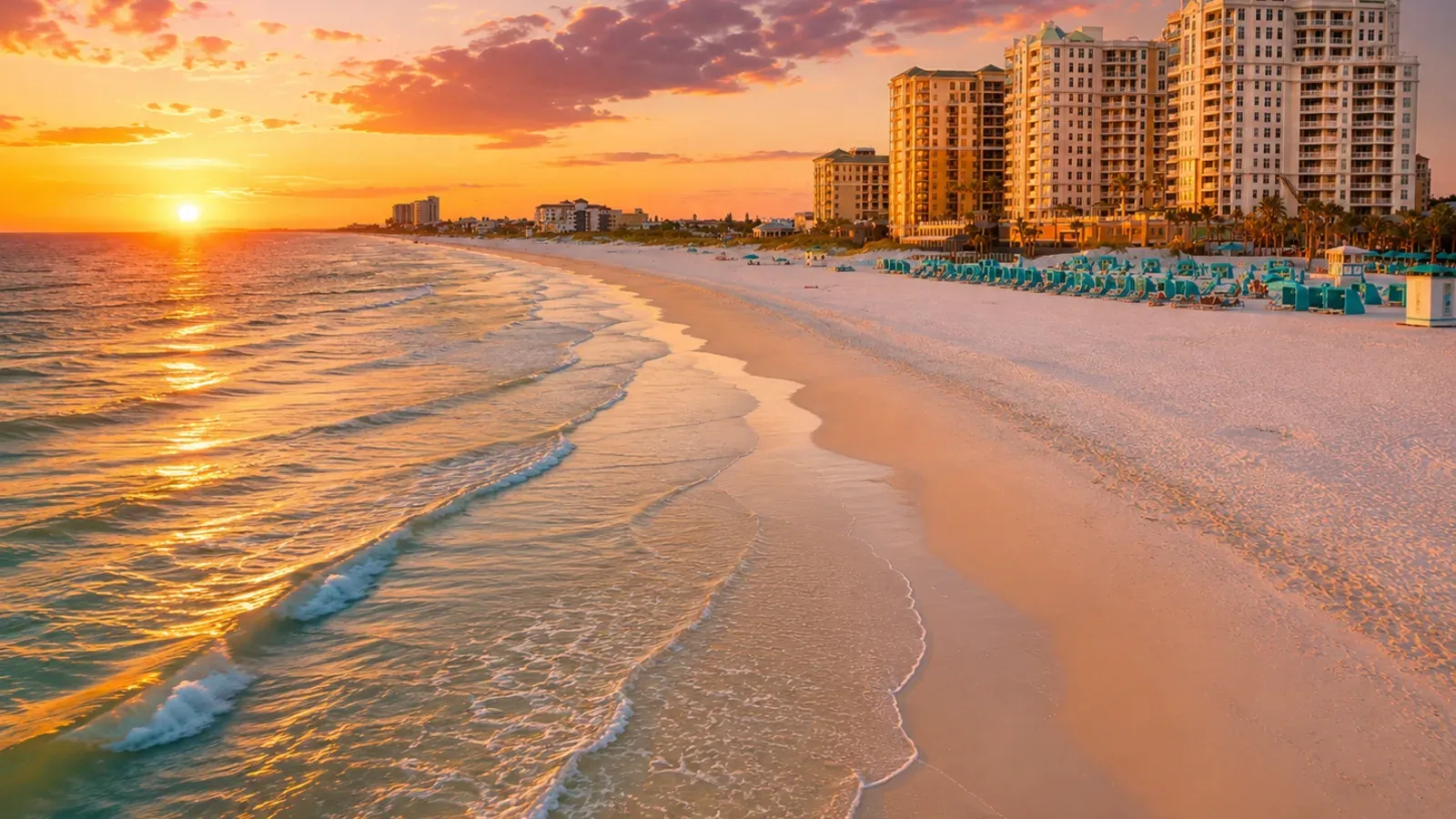
Clearwater short term rentals are legal only in specific cases. A normal house inside the city usually cannot be rented by the night.
I'm Troy Nowak, broker of Mangrove Bay Realty (FL license BK3436609). I help investors buy and sell Clearwater short term rentals and Pinellas Airbnb property. When someone sends me a Clearwater address, I check jurisdiction and zoning before the kitchen or the pool. City residential, Clearwater Beach legal-nightly paths, and unincorporated Pinellas are three different deals.
Who to ask: How he screens a Clearwater Airbnb. On the beach: best Airbnb realtor in Clearwater Beach.
Rules and next steps: Pinellas short-term rentals, investor guide, home value, contact.
Most ordinary residential property inside the City of Clearwater cannot simply be purchased and rented by the night. The city's rule generally requires a residential rental to be 31 days or one calendar month, whichever is less. A pool, a Clearwater mailing address, or an HOA that allows weekly rentals does not change the city's land-use rule.
Looking to buy a short-term rental in Clearwater?
The opportunities I look for usually fall into four lanes:
- A Clearwater or Clearwater Beach property with documented lawful nonconforming, often called grandfathered, short-term-rental status.
- A property approved for transient lodging, such as an appropriate hotel or condo-hotel use.
- A condo or townhome where the public rules and current association documents both allow the intended rental schedule.
- A property with a Clearwater mailing address that is actually governed by unincorporated Pinellas County.
This is a practical investor guide, not a legal opinion. The rules, association documents, and approval history can produce a different answer for two properties on the same street.
Clearwater short term rentals: city vs beach vs unincorporated
Before you underwrite, line the three paths up side by side. The mailing city on the listing is not the rulebook.
| Jurisdiction | Typical minimum stay | Nightly path? | What to verify first |
|---|---|---|---|
| City of Clearwater residential zoning | 31 days or one calendar month, whichever is less | Usually no | Zoning district, CDC 1-104.B / 3-919, written staff answer |
| Clearwater Beach (still City of Clearwater) | Same residential rule unless use is different | Only if transient, condo-hotel, or documented grandfathered use | Approved use, city nonconforming file, current condo/HOA docs |
| Unincorporated Pinellas (Clearwater mailing address) | County STR COU program (stays under 30 days, more than 3×/year) | Yes, with Certificate of Use | Parcel jurisdiction, pinellas.gov/str COU, occupancy/parking |
Last verified October 15, 2026 against the City of Clearwater code compliance handbook, ADU page, and Pinellas County STR Certificate of Use pages.
Can you run an Airbnb on Clearwater Beach?
Sometimes, but not on residentially zoned property. The City of Clearwater says a residential use on residentially zoned property cannot include rentals of less than 31 days or one calendar month, whichever is less. Owners in residential districts can advertise monthly rentals, not daily or weekly ones. Clearwater Beach is inside the city, so that rule applies to its residentially zoned streets too.
Source: City of Clearwater Code Compliance guide, Community Development Code Sections 1-104.B and 3-919. The city's ADU page says it plainly: short-term rentals are not permitted in residential zoning districts. Last verified October 15, 2026.
Legal nightly stays on the beach usually come from one of three places:
- Transient lodging use. Property approved for it, such as an appropriate hotel or condo-hotel use.
- Documented grandfathered status. A 2007 Pinellas circuit court judgment describes Clearwater Ordinance 7105-03, adopted April 17, 2003, and a suit by owners of 31 Clearwater Beach properties who said they rented short-term before it passed. Status like that needs a city record, not a listing claim.
- Condos or townhomes where both layers agree. The city use and the association documents both have to allow the schedule you plan.
Before you price a beach property as an Airbnb, get the zoning and approved use for your stay length from the city in writing, read the current condo or HOA rental rules, and confirm the parcel is in Clearwater at all. Some homes with a Clearwater mailing address sit in unincorporated Pinellas County, under the county's rules.
Why do Clearwater Airbnb rules confuse buyers?
"Clearwater" can describe a city, a beach market, or the mailing city printed on an address. Those are not interchangeable.
Inside incorporated Clearwater, normal residential zoning is restrictive. On Clearwater Beach, legally rentable supply may come from tourist uses, condo-hotel structures, or older documented nonconforming uses. Outside the city limits, an address may fall under Pinellas County's rules even though every listing site calls it Clearwater.
That is why I do not start with an Airbnb map or an MLS remark. I start with the parcel, jurisdiction, zoning, approved use, and recorded association documents.
The 2003 ordinance and Clearwater's grandfathered rentals
Clearwater did not invent this restriction during the recent Airbnb boom. The history goes back more than two decades.
A 2007 Pinellas County Circuit Court judgment describes Clearwater Ordinance 7105-03, adopted April 17, 2003. According to the judgment, the ordinance prohibited rentals of less than 31 days on residential properties. The lawsuit involved owners of 31 Clearwater Beach properties who said they had lawfully operated short-term rentals before the ordinance and sought recognition as lawful nonconforming uses.
That history matters because Florida law treats older local vacation-rental regulations differently. Florida Statutes section 509.032 generally prevents a local government from newly prohibiting vacation rentals or regulating their duration or frequency, but that limitation does not apply to local regulations adopted on or before June 1, 2011. Clearwater's 2003 ordinance predates that cutoff.
Clearwater's current code compliance handbook says a residential use on residentially zoned property cannot include rentals for less than 31 days or one calendar month, whichever is less. When the deal depends on short stays, I still ask the city for a written answer tied to the parcel and the proposed use. Last verified October 15, 2026.
Grandfathered status is paperwork, not a listing claim
Documented grandfathered properties are rare, and that scarcity can make them valuable. It also attracts sloppy marketing.
I want the paperwork. A current Airbnb listing, old booking reviews, a business tax receipt, or an MLS sentence that says "grandfathered" is not enough by itself. I want to see the city's record identifying the lawful nonconforming use, any conditions attached to it, and whether there has been a lapse or abandonment issue.
I would not tell a buyer that the right automatically survives every sale based on a seller's representation. Clearwater records discuss continuity and abandonment of nonconforming uses, but I have not found a current authoritative city source that supports a blanket transferability promise for every property. Before relying on the income, I would ask the City of Clearwater to confirm the status in writing for the specific parcel and proposed use after the sale.
Prefer to watch?
I explain the Clearwater and St. Pete areas where short-term rentals can work in this video.
The paths I would investigate
A documented nonconforming Clearwater property
This can be a compelling asset because the legal nightly-rental supply is constrained. The hard part is proving the use and understanding any conditions. I would not underwrite it until the city file supports the seller's story.
A transient-use or condo-hotel property
Some beach product is designed and approved for transient occupancy. That can solve the city-use question, but it does not solve the investment question. Rental program rules, management splits, owner-use limits, reserves, assessments, parking, and association restrictions can still change the return.
A condo or townhome with both layers aligned
An association can be stricter than the government, but it cannot make a use legal if the city or county does not allow it. I check the public approval first, then the declaration, bylaws, rental rules, meeting minutes, and pending amendments.
An unincorporated Pinellas property
This is the lane many buyers miss. The county has a separate short-term-rental framework for unincorporated Pinellas, including a Certificate of Use program and operating standards. The county adopted its current program in 2025.
Does a Clearwater mailing address mean Clearwater city rules?
No. A property's mailing city is used for mail delivery. It does not conclusively identify the government that controls zoning and short-term-rental use.
Some homes advertised as Clearwater are in unincorporated Pinellas County. That can mean a different rental path, but I still verify the official parcel record, jurisdiction, zoning, deed restrictions, and current county requirements before treating it as an STR. More detail: unincorporated Pinellas Airbnb rules.
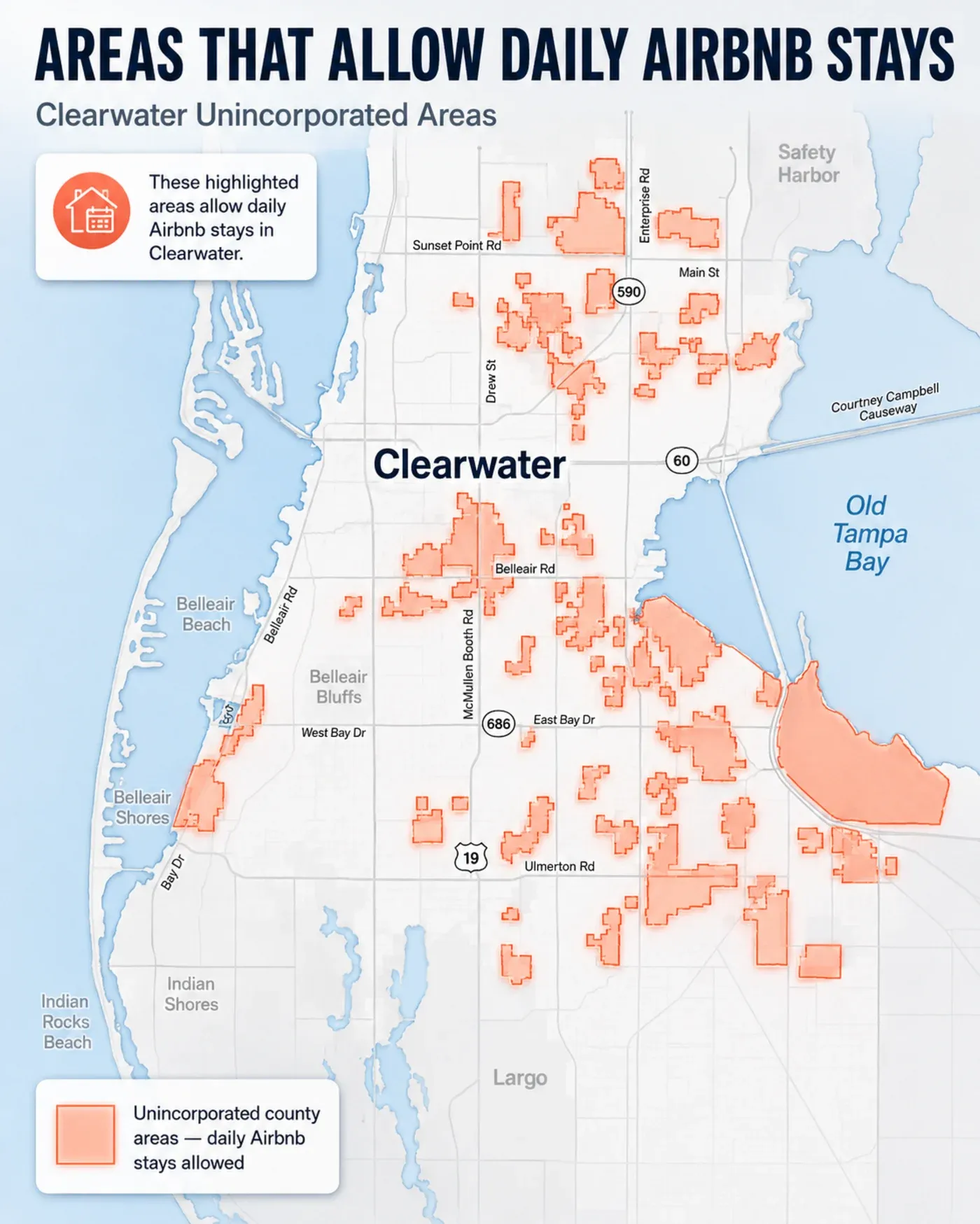
This map is a visual aid based on a source map. It is not legal proof that a specific parcel is unincorporated or eligible for daily rentals. Verify the exact parcel and jurisdiction with official county and city records before purchasing.
Pinellas County's zoning and land-use page links to the official county map and zoning-certification process. For an investment purchase, a zoning certification letter or written staff response is much better evidence than a screenshot.
Under the county's current Short-Term Rental Certificate of Use program, maximum occupancy is two guests per bedroom plus two additional guests in one common area, capped at 10 occupants. Guests of all ages count. The county also requires one off-street parking space for every three occupants, rounded up. Those limits matter when comparing a large home with a smaller beach unit. Last verified October 15, 2026.
Where I would actually look for a Clearwater-area Airbnb
I tend to put the best opportunities into two buckets. They are different investments, and I would not underwrite them with the same assumptions.
Clearwater Beach townhomes and appropriate condos
I like strong Clearwater Beach townhomes and condos when the nightly-rental use is clearly legal and the association documents cooperate. The supply is constrained, the location is hard to reproduce, and a good layout can serve family groups that want the beach without a hotel room.
As an illustrative underwriting case only, a strong legally rentable Clearwater Beach townhome purchased around $1.1 million could have a path toward roughly $200,000 in annual gross revenue with the right bedroom count, amenities, legal rental setup, pricing, and management. That example is illustrative, not a projection for any specific listing.
That is not a promise. Gross revenue is not profit, and every $1.1 million property will not produce $200,000. Debt service, association costs, management, utilities, cleaning, repairs, insurance, taxes, reserves, and owner use all come out of the top line. I use the example to show why scarce legal use can justify a closer look, not to manufacture a return.
Larger pool homes in unincorporated Pinellas
A four-bedroom or larger pool home in the right unincorporated pocket may offer a stronger cash-on-cash profile at a lower purchase price than a comparable beach property. It serves a different guest: larger families, multi-generational groups, and people who value space and a private pool over walking to the sand.
A larger inland home is a different bet. You may give up some beachfront scarcity and appreciation potential. Demand can be more seasonal, and the county's 10-person occupancy cap limits how much a large bedroom count can expand revenue.
I also watch neighboring jurisdictions with different lawful occupancy limits. Those differences can affect supply and group demand, but I verify the current rule before putting a guest count into a model.
For the broader parcel-screening process, use my Pinellas short-term-rental map and investor guide. It is the main informational starting point before moving into address-level work.
Have a property you're considering?
Send me the address. I can help you sort out which jurisdiction to verify, what records to request, and whether the property is worth underwriting.
How I verify a property before underwriting it
My sequence is short because I want to kill a bad deal before anyone wastes time on furniture plans.
- Confirm the parcel ID and whether the property is in Clearwater, another municipality, or unincorporated Pinellas County.
- Confirm zoning and the approved use for the exact stay length being modeled.
- Pull written proof for any claimed lawful nonconforming or transient use.
- Read the current condo, HOA, and deed restrictions. Do not rely on the listing agent's summary.
- Confirm occupancy, parking, registration, licensing, and tax requirements for the operator plan.
- Underwrite gross revenue, then subtract every operating and ownership cost. Keep a monthly or long-term fallback when the property supports one.
If a city or county answer is unclear, I describe the intended use in writing and ask for a written response tied to the parcel. A phone call is useful for direction. It is weak evidence for a seven-figure purchase.
Clearwater Airbnb questions I hear most
Can you Airbnb a normal house inside Clearwater city limits?
Usually not by the night if it is in a normal residential zoning district. Clearwater generally requires 31 days or one calendar month, whichever is less. Verify the exact parcel before relying on that general rule.
Are short-term rentals legal on Clearwater Beach?
Some are. Look for documented nonconforming properties, approved transient-use product, and condo-hotel or association situations where both the city use and private documents support the intended stay length. "On the beach" is not proof by itself.
Does a Clearwater mailing address mean Clearwater's 31-day rule applies?
No. It may be inside Clearwater, another municipality, or unincorporated Pinellas County. Verify jurisdiction from official parcel and government records.
Does an HOA that allows weekly rentals make the property legal?
No. The government must allow the use, and the association documents must also allow it. You need both layers.
Do grandfathered Clearwater STR rights transfer to a buyer?
Do not assume they do. Ask Clearwater to confirm the lawful nonconforming status, continuity, conditions, and post-sale treatment in writing for the specific property.
What is the unincorporated Pinellas occupancy limit?
The county's current rule allows two guests per bedroom plus two in a common area, with a maximum of 10 occupants, including children. Confirm that the property is actually in the county's unincorporated jurisdiction and review the full Certificate of Use requirements.
Thinking about buying a Clearwater or Pinellas County short-term rental?
If you're trying to figure out where to buy, what rules apply, or whether a property makes sense as an investment, I'm happy to talk through it with you. Call or text (727) 404-5530, email troynowakrealty@gmail.com, or use the contact form.