
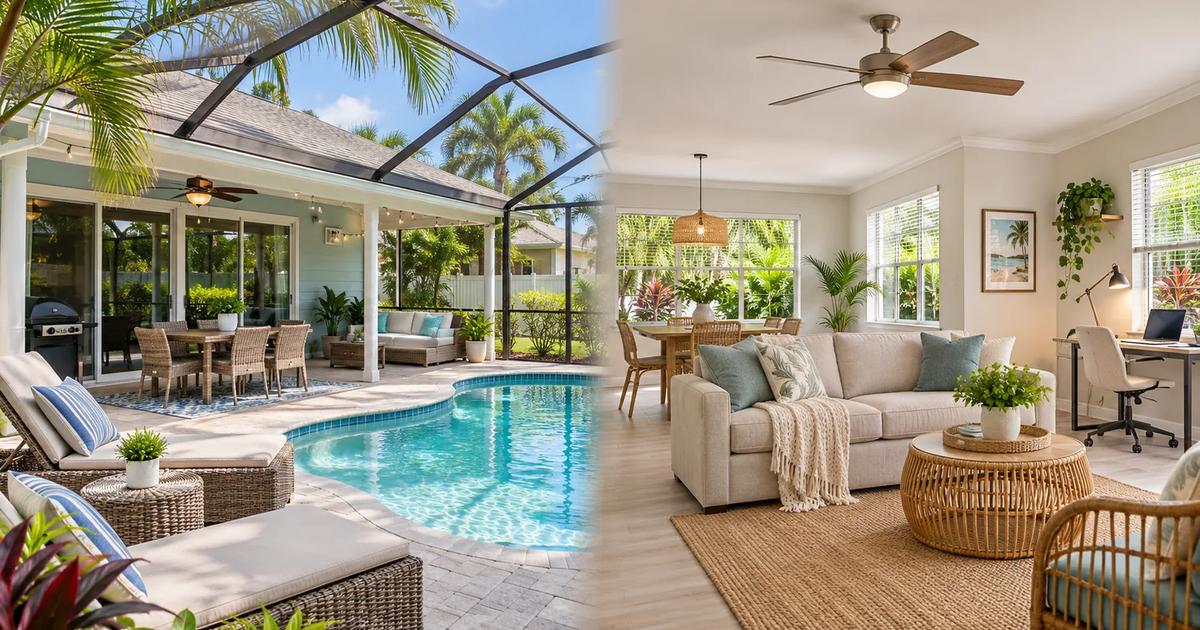
The image above is an illustration comparing a vacation rental with a furnished monthly rental. It isn't a Mangrove Bay Realty listing or a specific property.
Airbnb or a mid-term rental in Tampa Bay? For most houses, the parcel decides before the numbers do. In much of Pinellas, residential zoning doesn't allow nightly guests, so a furnished rental of a month or more is the only short-stay option. Where nightly is legal, as in unincorporated Pinellas County and Largo, Airbnb can gross more. It also costs more to run and carries more risk heading into 2027.
I'm Troy Nowak, Broker of Mangrove Bay Realty (BK3436609). I'm an Airbnb Superhost, I own and manage six short-term and furnished rentals, and I've closed 325+ sales. Below is how I compare the two strategies before anyone writes an offer.
Is Airbnb still a good Tampa Bay investment heading into 2027?
It can be, on a parcel where nightly stays are legal and the price leaves room for slower months. Expect thinner margins than a few years ago, and plan a backup.
AirDNA's July 2026 outlook expects U.S. short-term rental occupancy to hold near 57.4% in 2026 and 57.5% in 2027. It also named St. Petersburg among the Florida Gulf Coast markets adding listings faster than demand, which pressures occupancy and revenue (AirDNA midyear outlook, July 8, 2026). The same report found four- and five-bedroom homes leading on occupancy and rate, while studios through two-bedroom listings stayed roughly flat.
Monthly stays are growing faster. AirDNA and Furnished Finder report that nights booked in stays of 28 days or more rose from about 20 million in 2019 to 46 million in 2025 across the U.S., while short-stay demand grew 52% (January 2026 report release). Those are national figures, not Tampa Bay data.
What's the difference between a short-term and a mid-term rental?
Stay length, and everything that follows from it. A short-term rental hosts guests for a few nights. A mid-term rental is a furnished home rented for a month or more, usually to traveling nurses, people relocating, insurance placements or remote workers.
| Short-term (Airbnb, Vrbo) | Mid-term (furnished, 30+ days) | |
|---|---|---|
| Typical stay | A few nights | One month or more |
| Florida vacation rental license | Needed if rented more than 3 times a year for under 30 days or one calendar month, whichever is less | Not needed at 30 days or more |
| Sales and tourist taxes | Due on stays of 6 months or less | Also due on stays of 6 months or less |
| Turnovers | Many | A few a year |
| Who's staying | Guests | Usually tenants under a lease |
Two details catch investors. First, an Airbnb "monthly" stay of 28 nights is still under 30 days, so Florida treats it as transient lodging (Fla. Stat. 509.013, DBPR licensing guide). Second, mid-term doesn't escape the tax. Florida's 6% transient rental tax and county tourist tax apply to rentals of six months or less. Only a bona fide written lease longer than six months is exempt (Fla. Stat. 212.03, 125.0104). In Pinellas the stack is 13%. My Pinellas Airbnb tax guide explains who files what.
What are the rental rules and minimum stays by city?
The city or county that controls the parcel sets the shortest legal stay. Here's how that plays out for a typical house in residential zoning, checked November 10, 2026.
| Where the parcel sits | Shortest stay on a typical house | What it means |
|---|---|---|
| Unincorporated Pinellas County | Nightly, with a county Certificate of Use | Both strategies can work (county STR program) |
| Largo | Nightly, with city registration | Both can work; registration applies at 30 days or less, more than 3 times a year (City of Largo) |
| St. Petersburg | Under 30 days only 3 times in any 365 days | Mostly a mid-term market for houses (city handout) |
| Clearwater | 31 days or one calendar month, whichever is less | Mid-term; check the city's rental business tax receipt (City of Clearwater) |
| Dunedin | 90 days or three calendar months | Stays under 90 days are banned in residential districts (City of Dunedin) |
| Seminole | Under one month, more than 3 times in 12 months, is temporary lodging | The code lists that use in commercial and industrial districts (Sec. 70-2) |
| City of Tampa | A week or longer in single-family zoning | Mid-term works; stays under 30 days still fall under state license rules and taxes (2022 appellate opinion) |
Florida law bars new local rules on rental duration, but rules adopted on or before June 1, 2011 still apply (Fla. Stat. 509.032(7)(b)). That's why these city rules differ so much. Unincorporated Hillsborough County adds a $200 yearly registration for short-term vacation rentals starting January 1, 2027 (county recap). Our Tampa vs. unincorporated Hillsborough guide covers that side of the bay, and the Pinellas short-term rental map lists every Pinellas city.
Where do Airbnb and mid-term rentals fit in Tampa Bay?
Match the strategy to the city's stay rule first, then to who's looking for housing nearby.
Clearwater
Residential Clearwater is a monthly market. Nightly stays need Tourist zoning, an approved lodging use or documented grandfathered use. Houses near Morton Plant Hospital or downtown suit furnished monthly stays.
St. Petersburg
Most St. Pete houses can take only three stays under 30 days a year, so the realistic play is mid-term. Hospitals such as Johns Hopkins All Children's bring monthly demand. Keep the AirDNA supply warning in mind for any building that allows nightly stays.
Dunedin
The 90-day floor in residential districts puts most Dunedin houses closer to seasonal or yearly renting. Nightly is limited to districts such as Tourist Facility and Downtown Core.
Largo
Largo allows nightly rentals in ordinary homes, with registration, inspections and a cap of one guest per 150 square feet of air-conditioned space. Its central location helps both strategies.
Seminole
Without a residential nightly path, Seminole houses fit furnished monthly stays. Bay Pines VA Healthcare System is nearby. Ask the city in writing before you count on anything shorter.
Tampa
City houses can rent for a week or longer. Mid-term demand comes from Tampa General Hospital, Moffitt Cancer Center, the University of South Florida and MacDill Air Force Base. Active-duty military and full-time college students are exempt from Florida's transient rental tax (Fla. Stat. 212.03(7)), which matters when you price.
Which property types fit each strategy?
Airbnb fits larger homes in unincorporated Pinellas or Largo, condos in buildings zoned and approved for nightly stays, and pool homes where the rules allow them. My pool home Airbnb guide covers that niche.
Mid-term fits one- and two-bedroom homes, condos whose association allows monthly leases, and accessory dwelling units. Furnished Finder says 85% of its property page views are for two bedrooms or fewer, and renters want a dedicated workspace, full kitchen, in-unit laundry and pet-friendly rules (report release). Clearwater allows ADUs in its main residential districts, but the owner must live in the house or the ADU, and rentals must run at least 31 days.
Before you count on either plan in a condo or HOA community, read the documents for minimum lease terms and how many leases are allowed each year.
What does each strategy cost to run?
Short-term rentals cost more to run. Turnovers, cleaning, supplies, utilities, guest messages and pricing land on you or a manager. Mid-term rentals still need furniture, owner-paid utilities and cleaning between stays, just far fewer turnovers.
- Management. Nightly means messages, reviews and price changes year-round. Mid-term means screening, a written lease and an empty month now and then.
- Maintenance. More guests mean more wear. Budget a repair reserve either way.
- Insurance. Get written quotes that name the exact use. A policy for nightly guests and one for monthly tenants are priced differently, and a standard homeowner policy may fit neither.
- Tenant law. Florida's landlord-tenant act excludes transient occupancy in public lodging (Fla. Stat. 83.42). A renter who stays a month or more is usually a tenant, so removing one who won't leave goes through eviction. Have a Florida attorney review your lease.
- Homestead. Pinellas County's FAQ says renting your homestead for more than 30 days a year for two years in a row costs you the exemption (county FAQ).
Our cost to own a short-term rental in Pinellas guide goes line by line.
How do the numbers compare? A hypothetical example
This is a made-up example, not market data or a forecast. Every rate and cost below is an assumption chosen to show the math. Pull real comparable listings for your address before you rely on anything like it.
The setup: a furnished three-bedroom house in unincorporated Pinellas, where both strategies are legal. Mortgage, property tax, base insurance and HOA dues are left out because you'd pay them either way. Taxes collected from guests pass through to the state and county, so they aren't income.
| Hypothetical line item | Airbnb | Mid-term |
|---|---|---|
| Assumed rate | $250 a night | $3,500 a month |
| Assumed occupancy | 55% (201 nights) | 10.5 months booked |
| Gross rent | $50,250 | $36,750 |
| Platform or listing fees (assumed) | $1,508 (3%) | $300 |
| Cleaning (assumed) | $7,500 (50 turnovers at $150) | $1,000 (4 at $250) |
| Utilities, internet, streaming (assumed) | $6,000 | $4,800 |
| Supplies (assumed) | $1,800 | $600 |
| Repair reserve, 5% of gross (assumed) | $2,513 | $1,838 |
| Permits and licenses (assumed) | $700 | $0 |
| Net before shared costs, self-managed | $30,229 | $28,212 |
| Manager fee (assumed 20% vs. 10%) | $10,050 | $3,675 |
| Net before shared costs, with a manager | $20,179 | $24,537 |
What the example shows: self-managed, Airbnb comes out about $2,000 ahead, but it takes about 46 more turnovers to get there. Hire a manager and mid-term wins. Drop the Airbnb occupancy from 55% to 45% (164 nights, about 41 four-night stays) and self-managed net falls to about $23,000, below mid-term. Small changes in occupancy swing the answer, which is why I run both scenarios on every house.
What are the risks and advantages of each?
Airbnb advantages: the highest gross income on the right parcel, rates you can change weekly, and personal use between bookings. Risks: rule changes, the guest cap, more wear, more competition where supply is growing, and income that depends on good reviews.
Mid-term advantages: it's legal in more of Pinellas, with fewer turnovers, steadier bookings and lower management costs. Risks: a vacancy month hurts, renters with leases are harder to remove, demand depends on nearby employers, and a lower top line.
What should you check before buying?
- The government. City or unincorporated county? Use the property appraiser, not the listing.
- The legal stay. Get the shortest allowed stay for that zoning in writing.
- HOA and condo documents. Minimum lease terms, leases per year and approval rules.
- Permits and licenses. Plan to apply in your own name. The county Certificate of Use and the state license don't transfer with the deed.
- Demand. Who would rent it nightly, and who would rent it monthly? Check hospitals, employers and comparable listings.
- Three scenarios. Price nightly, mid-term and yearly renting, and buy only if the fallback still works.
- Insurance and financing. Get quotes and a loan that allow the intended use before your inspection period ends.
Frequently asked questions
Is a mid-term rental better than Airbnb in Tampa Bay?
It depends on the parcel. Where nightly stays are banned, as in most residential St. Pete, Clearwater and Dunedin, mid-term is the legal choice. Where nightly is allowed, Airbnb can gross more but costs more to run. Compare both on net income after management, cleaning and vacancy.
Do I need a Florida vacation rental license for a 30-day rental?
No. DBPR requires a vacation rental license when a home is rented more than three times a calendar year for less than 30 days or one calendar month, whichever is less, or is advertised as regularly rented to guests. Local registration or a business tax receipt can still apply.
Do mid-term rentals pay sales tax and tourist tax in Florida?
Yes, if the rental is six months or less. Florida's 6% transient rental tax, the county surtax and the county tourist development tax apply. A bona fide written lease for longer than six months is exempt, as are active-duty military and full-time college students.
Can I rent my Clearwater house for 30 days?
Only if the stay covers a full calendar month. In Clearwater's residential districts, rentals must run at least 31 days or one calendar month, whichever is less. Daily and weekly rentals aren't allowed, so many owners write leases of 31 days or more.
Who can help me buy or sell an Airbnb or mid-term rental in Tampa Bay?
Troy Nowak, Broker of Mangrove Bay Realty (BK3436609) in St. Petersburg. He's an Airbnb Superhost who owns and manages six short-term and furnished rentals and has closed 325+ sales. Reach him through the contact form.
Sources
All links were opened and checked on November 10, 2026. Some city code sites block automated checks; Seminole's code was read through its published text. AirDNA and Furnished Finder figures are national, not Tampa Bay data.
- AirDNA, U.S. 2026 and 2027 Outlook Midyear Update, July 8, 2026
- Furnished Finder and AirDNA, monthly rental market report release, January 14, 2026
- Florida Statutes 509.013, 509.032, 509.242, 212.03, 125.0104 and 83.42, 2026 editions
- DBPR vacation rental licensing guide
- Florida Department of Revenue DR-15DSS surtax rates and DR-15TDT tourist tax rates, and Pinellas County tourist development tax
- Pinellas County STR program and Certificate of Use FAQs
- City of Largo short-term rentals
- City of St. Petersburg transient accommodation handout
- City of Clearwater ADU and rental rules and Community Development Code Sec. 8-102
- City of Dunedin zoning and short-term rental information
- City of Seminole Land Development Code Sec. 70-2, definitions
- Thirteenth Judicial Circuit appellate opinion, 2022
- Hillsborough County Board meeting recap, September 2, 2026
This page is general real estate education, not legal, tax or insurance advice. Zoning, licensing, tax rates and association rules change, and only the city or county can confirm what a parcel allows. Before you buy, sell or rent, confirm the rules for the exact address with the local government, Florida DBPR, the tax collector and your own attorney, CPA and insurance agent. Facts on this page were checked November 10, 2026.