Last Updated: September 23, 2026
Fast answer for STR / Airbnb buyers: This is the purchase underwrite / deal screen for Clearwater — not a lifestyle homebuyer handbook and not a market-forecast essay. Before you write an offer, screen mainland Clearwater vs Clearwater Beach product, then jurisdiction + legal stay length + flood/insurance quotes + HOA/condo lease traps + 30+ / 31-day midterm fallback. Inside City of Clearwater residential districts, city materials say short-term rentals are not permitted — rentals must be for 31 days or one calendar month, whichever is less. Beach transient / nonconforming claims and unincorporated Pinellas are different lanes. Deep rules stay on Clearwater STR rules. Market product framing stays on yesterday's Clearwater STR buy screen. This page is how you price and contingency the purchase.
Review STR Deal: Send the address and asking price. I will mark city vs county, mainland vs Beach, flood/insurance pressure, HOA traps, and whether the deal still works as a furnished 30+ / 31-day rental before you burn inspection money.
What this page owns (so we do not duplicate)
| Page | Job |
|---|---|
| Clearwater STR rules | Stay-length / zoning / BTR / nonconforming deep dive |
| Clearwater STR market buy screen | Mainland vs Beach product screen + investor framing |
This guide (clearwater-home-buying-guide-2026) | Purchase deal screen: underwrite order, contingencies, flood as purchase support, HOA traps in contract, midterm floor for offer price |
Pinellas framing: short-term rentals hub. Portfolio buyers: investor guide. Flood tools: flood zones hub.

Clearwater STR purchase deal screen
Run this before you compete on price. Numbers without legality are not equity.
| Deal step | What must clear before you remove contingencies |
|---|---|
| 1. Product | Mainland city residential vs Beach / Sand Key / Island Estates — different comps, insurance, HOA risk |
| 2. Jurisdiction | City of Clearwater vs unincorporated Pinellas vs another Pinellas city — mailing city is not proof (Pinellas County Property Appraiser) |
| 3. Legal stay path | City residential 31-day / calendar-month guidance; county Certificate of Use if unincorporated; Beach transient / nonconforming only with paperwork |
| 4. Private docs | HOA / condo lease minimums, rental caps, investor bans, parking / guest rules |
| 5. Flood + insurance | FEMA MSC + city / county flood materials; real wind / flood / liability quotes for intended use |
| 6. Fallback floor | Furnished 30+ / 31-day and long-term rents — if those fail, nightly usually fails harder |
| 7. Licenses / taxes | City residential-rental Business Tax Receipt where applicable; sales / tourist tax path — verify current fees on official pages |
| 8. Offer structure | Inspection, document, insurance, and association-review contingencies that match the risk |
Review STR Deal: Send the address if you want this table marked against a live listing.
Mainland vs Beach: buy the product you can operate
Do not price a mainland house off Beach condo comps, and do not underwrite Beach scarcity into a city residential nightly calendar.
| Product | Purchase underwrite bias | What usually breaks the deal |
|---|---|---|
| Mainland Clearwater (city residential) | Midterm-first: 31-day / monthly furnished + long-term floor | Stay-length mismatch, HOA lease minimum, insurance on older stock |
| Clearwater Beach / Sand Key | Tourist demand only if use is legal and association cooperates | Flood / wind quotes, condo fees / reserves, parking, missing transient or nonconforming proof |
| Island Estates / waterfront pockets | Waterfront guest profile with heavier diligence | Elevation, seawall / dock, insurance stack, HOA |
| "Clearwater" mailing address in unincorporated Pinellas | Possible county Certificate of Use path for qualifying STRs | Assuming city rules (or Beach comps) on a county parcel |

Buy-screen translation: Beach can support a premium purchase price when legality + association + insurance still leave margin after a midterm floor. Mainland city residential usually prices as a monthly / midterm asset. Full product framing: Clearwater STR market buy screen.
Jurisdiction and stay length — confirm before the offer, not after
City of Clearwater residential path
The City of Clearwater ADU materials state that short-term rentals are not permitted in residential zoning districts. In those districts, rentals must be for periods of 31 days or one calendar month, whichever is less. Source: City of Clearwater ADU page.
The city's Code Compliance citizen guide matches that frame for residentially zoned property: no lease or advertising for periods less than 31 days or one calendar month. Source: Citizens Guide to Code Compliance and the code compliance handbook PDF.
Purchase translation: do not write an offer whose pro forma needs illegal nightly income on ordinary city residential. Underwrite 31-day / monthly furnished first unless you have parcel-specific written confirmation of a lawful nonconforming use, approved transient lodging path, or another jurisdiction. For grandfathered claims and Beach condo-hotel paths, use Clearwater STR rules — verify on the official page; do not invent fees.
Business Tax Receipt is not zoning permission
If you rent inside the city, review Clearwater Business Tax Receipts. Residential rentals need the applicable BTR path. A BTR does not create a nightly-stay right that zoning and association docs deny. Confirm city limits on the Property Appraiser before you apply. Fee schedules change — verify on the official page.
Unincorporated Pinellas near Clearwater
Some listings marketed as "Clearwater" sit in unincorporated Pinellas. That can open a county Short-Term Rental Certificate of Use path for properties rented less than 30 days more than three times per year, or advertised as regular guest rentals. Start here and re-check current fees / forms on the official page: Pinellas County STR program.
Practical notes from the county page (verify before you underwrite — fees and forms change):
- Certificate of Use + inspection path for qualifying STRs
- Occupancy and off-street parking standards
- Quiet hours and responsible-party posting requirements
- Structures that do not qualify (sheds without utilities, RVs / campers, tents, unmodified shipping containers)
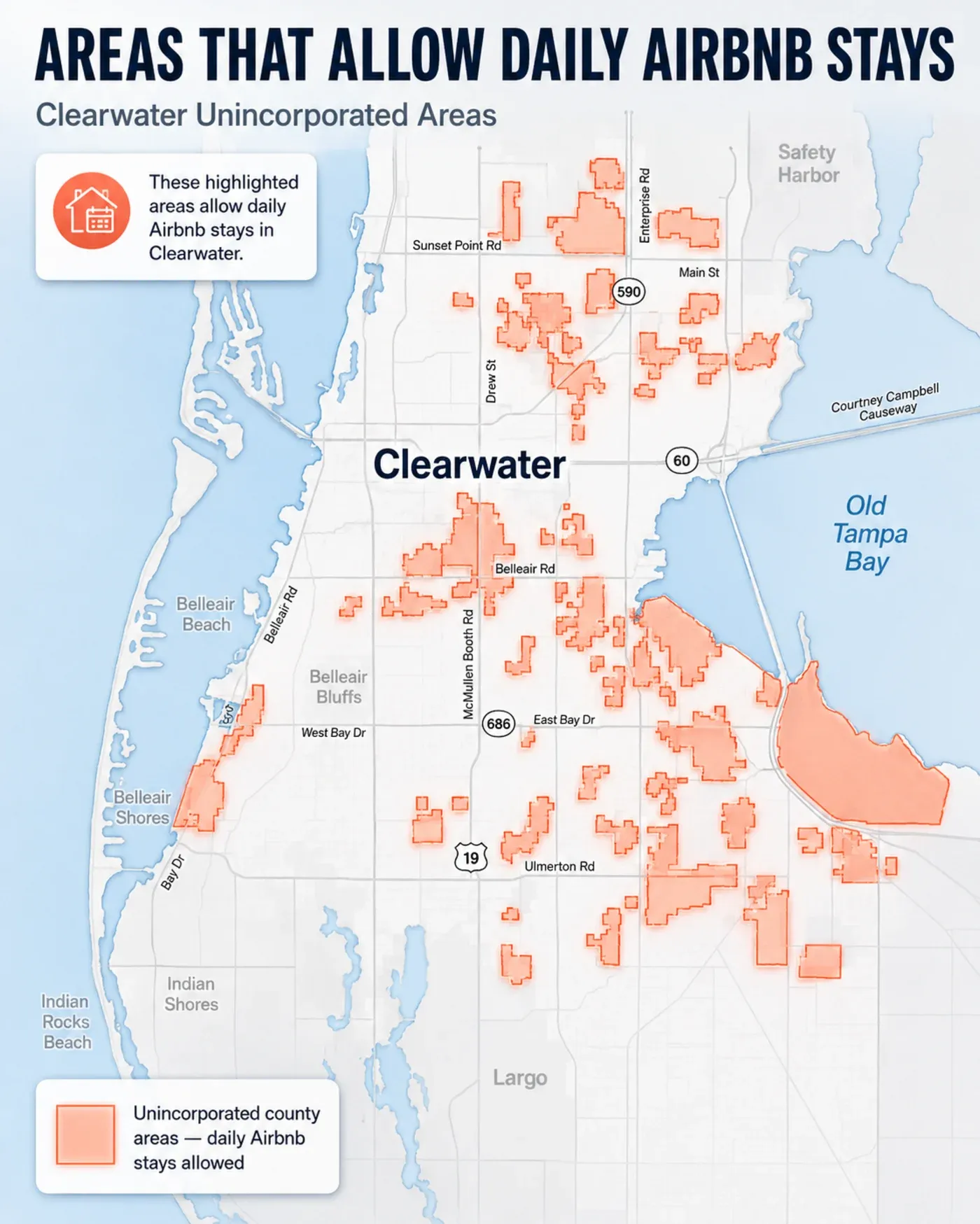
Visual aid only — not legal proof a parcel is unincorporated or nightly-eligible. Confirm on Property Appraiser / city-county records.
Flood and insurance as purchase support
Flood zone, evacuation zone, and storm surge are different checks. Pinellas County explains that on Flood Maps & Zones. City materials: Clearwater Flood Zones & Elevations. Confirm the effective FEMA product in the FEMA Flood Map Service Center.
Beach and waterfront stock usually carries heavier wind / flood diligence than inland mainland addresses. That is purchase support — quotes and contingencies — not a reason to skip them.
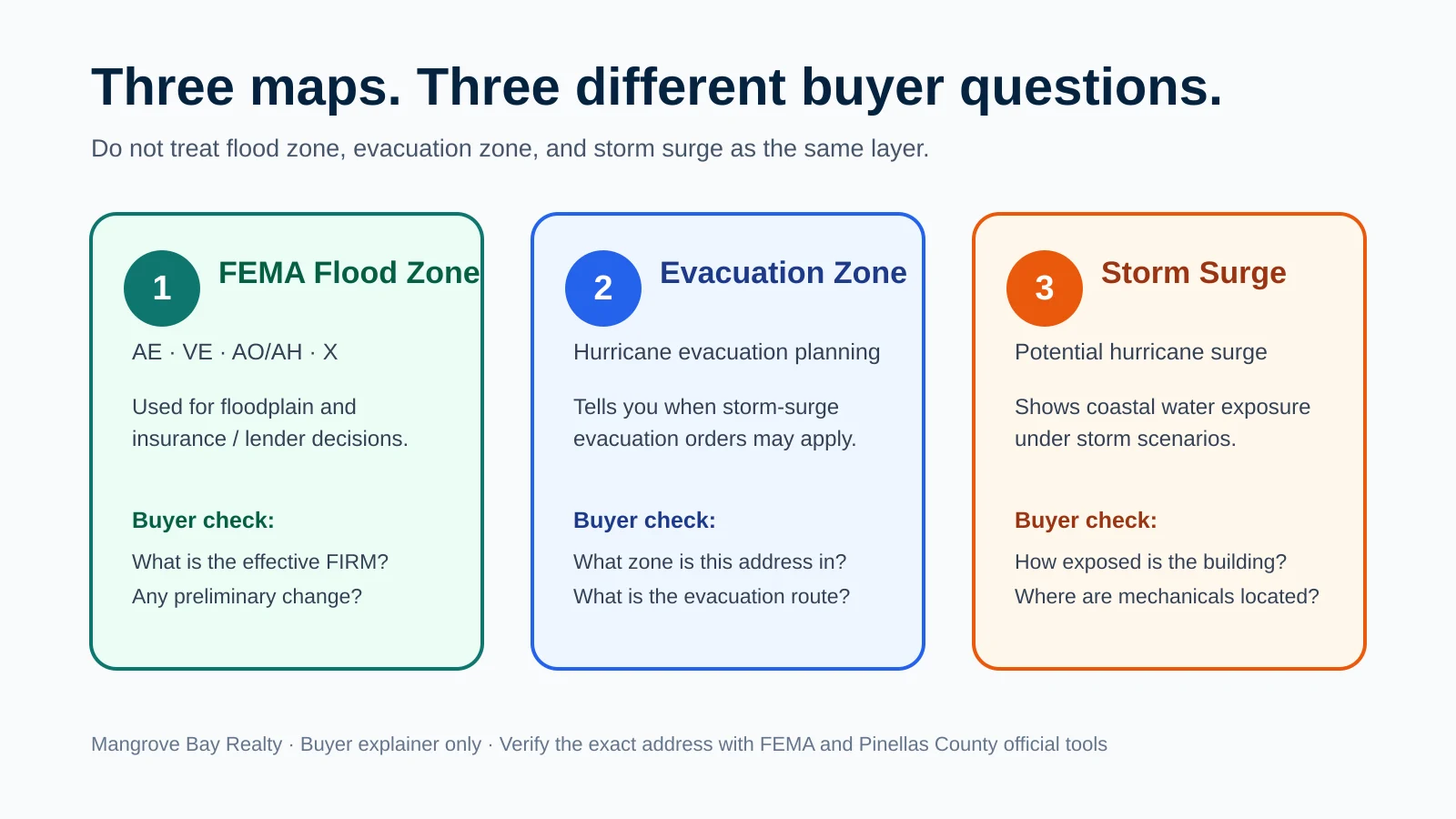
Educational explainer only — not an official flood map. Verify the exact parcel with FEMA / county / city tools.
Buyer order inside the contract:
- FEMA flood zone for the exact address
- Evacuation / surge context (Beach, Sand Key, Island Estates especially)
- Elevation certificate if available; decide whether to order one in diligence
- Real wind + flood + liability quotes for the intended use (second home vs rental)
- Roof age, openings protection, claims history, and post-storm disclosures
- If renovating in a mapped hazard area, ask Clearwater / county floodplain staff about substantial-improvement limits before you rely on the remodel budget
I am not inventing premiums, ADR, occupancy, or yield here. The only insurance number that matters is a quote for that address and that coverage.
More depth: flood zones hub | Pinellas flood zones by address guide | STR + flood zoning checklist
Review STR Deal: Send the address if flood or insurance is the line item that makes or breaks the offer.
HOA and condo traps in the purchase timeline
City / county rules are only half the screen. Association documents can kill a nightly (or even monthly) model — especially on Beach and Sand Key condos. Pull docs before you fall in love with the view.
Watch for:
- Minimum lease terms longer than your model (30, 90, 180+ days are common)
- Rental caps, waiting lists, or investor bans
- Guest / parking / occupancy rules that conflict with platform bookings
- Master insurance deductibles and special-assessment risk on condos
- Approval processes that delay first occupancy past your carry assumptions
An HOA that "allows weekly rentals" does not override city residential stay rules. You need both layers: public permission and private permission. Build association-document review into the contract calendar, not into a hope-and-pray after inspection.

Midterm (30+ / 31-day) fallback is the offer floor
Inside City of Clearwater residential districts, furnished 31-day / calendar-month is often the honest operating model. Price the purchase as if that is what you get.
Underwrite in this order:
- Legal stay path for the parcel (city vs county vs Beach transient / nonconforming claim)
- HOA / condo lease minimum
- Achievable 30+ / 31-day furnished rent and vacancy
- Long-term unfurnished rent as the hard floor
- Nightly ADR only if legality + docs + insurance still leave margin
If the deal only works as an unsupported nightly listing inside city residential zoning, it is not a deal — renegotiate to midterm economics or pass.
Pass / renegotiate triggers (purchase)
- Nightly pro forma on ordinary city residential with no verified exception
- Beach comps used to price a mainland house
- Condo / HOA lease minimum longer than your model
- Flood + wind quotes that wipe cash flow after realistic vacancy
- Grandfathered / nonconforming claim with no city paperwork
- Operator plan that ignores BTR, taxes, cleaning, reserves, and responsible-party rules
- Inspection budget that ignores floodplain substantial-improvement limits
STR purchase checklist (print this)
- Product — mainland vs Beach / Sand Key / Island Estates
- Jurisdiction — city vs unincorporated; confirm on Property Appraiser
- Legal stay length — city 31-day guidance / county Certificate of Use / transient or nonconforming file
- Private restrictions — HOA / condo declaration, rules, leasing addenda
- Licenses & taxes — city BTR if applicable; sales / tourist tax path (verify current fees)
- Flood & elevation — FEMA MSC + Pinellas + Clearwater flood materials
- Insurance stack — wind, flood, liability quotes before contingency removal
- Operations — parking, occupancy, quiet hours, responsible party, trash
- Fallback math — 30+ / 31-day furnished and long-term rents as the purchase floor
- Exit — who buys this if STR rules tighten further?
- Offer structure — inspection, document, insurance, and association contingencies that match the risk
Taxes after purchase: use the Pinellas tax estimator with your purchase-price assumptions — do not copy the seller's bill into your pro forma.
Official sources (verify before you offer)
- City of Clearwater ADU page (includes residential STR stay rule)
- City of Clearwater Citizens Guide to Code Compliance
- Clearwater code compliance handbook (PDF)
- City of Clearwater Business Tax Receipts
- City of Clearwater Flood Zones & Elevations
- Pinellas County STR Certificate of Use program
- Pinellas County Property Appraiser
- Pinellas County Flood Maps & Zones
- FEMA Flood Map Service Center
Frequently asked questions
Is this still a Clearwater home buying guide?
Yes — for STR / midterm investors underwriting a purchase. It is not a first-time lifestyle handbook. If you need market product framing, use the Clearwater STR market buy screen. If you need stay-length detail, use Clearwater STR rules.
Can I run a daily Airbnb inside Clearwater city limits?
Treat ordinary residential zoning as not daily-Airbnb by default. City materials point to a 31-day or one calendar month minimum in residential districts. Confirm the exact address, zoning, and documents before you model nightly income.
How should flood risk change my offer?
Pull the FEMA map for the exact address and get real quotes before you remove insurance contingencies. Do not use a countywide average premium. Use /flood-zones and the FEMA MSC before you stretch for waterfront ADR.
What if the HOA says weekly but the city says 31 days?
Believe the stricter layer that applies. City zoning and association docs both have to work. Renegotiate for midterm economics, or pass.
What is the safest underwriting path if nightly is uncertain?
Model 31-day / 30+ furnished and long-term rents first. If those fail, nightly usually does not rescue the purchase when rules or HOA docs cut occupancy.
Review STR Deal with Troy
If you are buying Clearwater or Clearwater Beach for Airbnb, midterm, or a hybrid rental plan, skip the generic homebuyer handbook and run the purchase deal screen.
Bring the address, asking price, intended stay length, and any HOA / condo docs you have. I will help you decide pass, renegotiate, midterm fallback, or proceed.
Related guides: Short-term rentals hub | Clearwater STR rules | Clearwater STR market buy screen | Flood zones hub | Investor guide | Pinellas flood zones guide | Contact
Educational real-estate information only — not legal, tax, or insurance advice. City and county rules, FEMA maps, fees, and association documents change. Verify the exact parcel with the applicable government agencies, insurer, lender, association, and qualified professionals before making a purchase decision.