
What we'll cover
- 1.What the Clearwater code says
- 2.Prefer to watch? A short Clearwater STR walkthrough
- 3.Where in Clearwater can you rent nightly: city vs Clearwater Beach vs unincorporated Pinellas?
- 4.What is the Clearwater 31-day minimum, and who does it apply to?
- 5.What are the short-term rental rules in Clearwater Beach?
- 6.What does grandfathered mean in Clearwater, and does it transfer to a buyer?
- 7.A Clearwater mailing address does not mean Clearwater city rules
- 8.An HOA that allows weekly rentals does not make it legal
…and 4 more sections below.
Yes, but only on some Clearwater parcels. A home on residentially zoned land inside city limits can't be rented for less than 31 days or one calendar month, whichever is less. Nightly stays need Tourist zoning, an approved lodging use, a documented grandfathered rental, or an address that is really in unincorporated Pinellas County.
I'm Troy Nowak, broker of Mangrove Bay Realty. I help investors buy and sell short-term rentals in Clearwater and the rest of Pinellas. When a buyer sends me a Clearwater address, I check the government and the zoning before I look at the pool. This page covers the rules. For Clearwater Beach buildings, listings and deal math, read my Clearwater Beach short-term rental guide.
What the Clearwater code says
A normal house in a city residential zone can't be rented for less than 31 days. The city code says a residential use on residentially zoned property "shall not include rentals for periods of less than 31 days or one calendar month, whichever is less." It also can't be advertised that way.
That rule comes from the definitions in the Clearwater Community Development Code, Section 8-102. Section 1-104.B adds that no land may be used unless the use fits its zoning district (Article 1). The city's code compliance guide says owners in residential districts may advertise monthly rentals, not daily or weekly ones. The city's ADU page says short-term rentals are not permitted in residential zoning districts.
Ask what is legal on one parcel, not whether Airbnb is legal in the whole city.
Prefer to watch? A short Clearwater STR walkthrough
Open the video on YouTube. The written rules on this page are the ones to rely on.
Where in Clearwater can you rent nightly: city vs Clearwater Beach vs unincorporated Pinellas?
It depends on who governs the parcel and how it is zoned. The mailing city on a listing is not the rulebook.
| Where the parcel sits | Shortest stay on a normal home | Nightly path? | What to check first |
|---|---|---|---|
| City of Clearwater, residential zoning | 31 days or one calendar month, whichever is less | Usually no | Zoning district, CDC 8-102 and 3-919, a written city answer |
| Clearwater Beach (still the City of Clearwater) | Same rule on residentially zoned land | Only with Tourist zoning, an approved lodging use, or documented grandfathered use | Zoning, approved use, any city nonconforming record, condo or HOA rules |
| Unincorporated Pinellas with a Clearwater address | County program for stays under 30 days, more than 3 times a year | Yes, with a county Certificate of Use | Parcel jurisdiction, pinellas.gov/str, occupancy and parking |
Last verified October 25, 2026 against the city code on Municode, the city code compliance guide, and Pinellas County pages.
What is the Clearwater 31-day minimum, and who does it apply to?
It applies to residentially zoned property inside city limits. Section 8-102 lists those districts: Low Density Residential (LDR), Low Medium Density Residential (LMDR), Medium Density Residential (MDR), Medium High Density Residential (MHDR), High Density Residential (HDR), the Neighborhood Conservation Overlay (NC) and Mobile Home Park (MHP).
The city does not need to catch a guest in the house. Section 3-919 lists what counts as prima facie evidence of a short stay in a residential zone. Any one of these can be enough:
- A state registration or license for short-term or transient rental under Florida Statutes Chapters 212 or 509.
- Advertising the home for tourist or vacation rental use.
- Bookings, or more than one lease, that cover any period under 31 days or one calendar month.
- Using an agent or other third person to take bookings.
Two other terms in Section 8-102 matter for buyers:
- Overnight accommodations means units offered for less than 31 days or one calendar month. The code says this is decided without regard to the form of ownership. A condo unit is judged by how it is used, not by the fact that it is a condo.
- Resort attached dwellings are attached dwellings in the Tourist (T) district that may be offered for any term. The city use chart (Chart 2-100) lists that use only in the T district.
The chart also lists overnight accommodations as a use in several districts, including some residential ones. The code notes that an "X" in the chart does not show what approval is needed. That is a lodging use with its own approval. It is not the same as renting out a normal house.
What are the short-term rental rules in Clearwater Beach?
Clearwater Beach is inside the City of Clearwater, so residentially zoned beach streets follow the same 31-day rule. Nightly stays on the beach come from Tourist zoning, an approved lodging use, or a documented grandfathered rental. Which buildings and townhomes fit is a building-by-building question, and I cover it in the Clearwater Beach guide.
What does grandfathered mean in Clearwater, and does it transfer to a buyer?
Grandfathered means the rental use started before the rule and was allowed to continue as a lawful nonconforming use. In the 2007 case, the trial court said a lawful nonconforming use runs with the land, not with the owner. It can still be lost, so get the city to confirm it in writing for your parcel and your plan.
The rule dates to Ordinance 7105-03, adopted April 17, 2003. That date appears in the history note under Section 3-919. A May 3, 2007 City Council agenda packet includes a Final Declaratory Judgment entered April 20, 2007. It found that 31 North Clearwater Beach properties were grandfathered and could keep short-term rental use. The same packet asked council to authorize an appeal. I have not found the outcome of that appeal in an official source, so I verify each parcel on its own.
State law explains why the older rule still stands. Florida Statutes 509.032(7)(b) says a local law may not prohibit vacation rentals or regulate how long or how often they are rented. It also says that limit does not apply to local rules adopted on or before June 1, 2011. Clearwater's 2003 rule is older than that cutoff.
How a grandfathered rental can be lost
The city code ties the loss of a nonconforming use to a break in use or to major damage. Section 6-103 says:
- If the use stops or is abandoned for 180 days in a row, it can't be started again.
- A nonconforming use can't be expanded.
- If the building is damaged to 50 percent or more of its assessed value, it may be rebuilt only if the building and the use conform to the code.
- Under 50 percent, the use may come back if permit applications are filed within six months of the damage.
That is why I ask for proof of steady use, not just an old listing. A gap between owners can matter.
The state license is a separate item. Florida Statutes 509.241 says a lodging license is not transferable from one place or person to another. A buyer needs their own. For what moves at closing and what doesn't, read buying an operating Airbnb in Pinellas County.
A Clearwater mailing address does not mean Clearwater city rules
No. A mailing city is for mail. It does not tell you which government controls zoning.
Some homes listed as Clearwater are in unincorporated Pinellas County. Those follow the county's short-term rental program instead of the city's 31-day rule. More detail is in my unincorporated Pinellas Airbnb rules post.
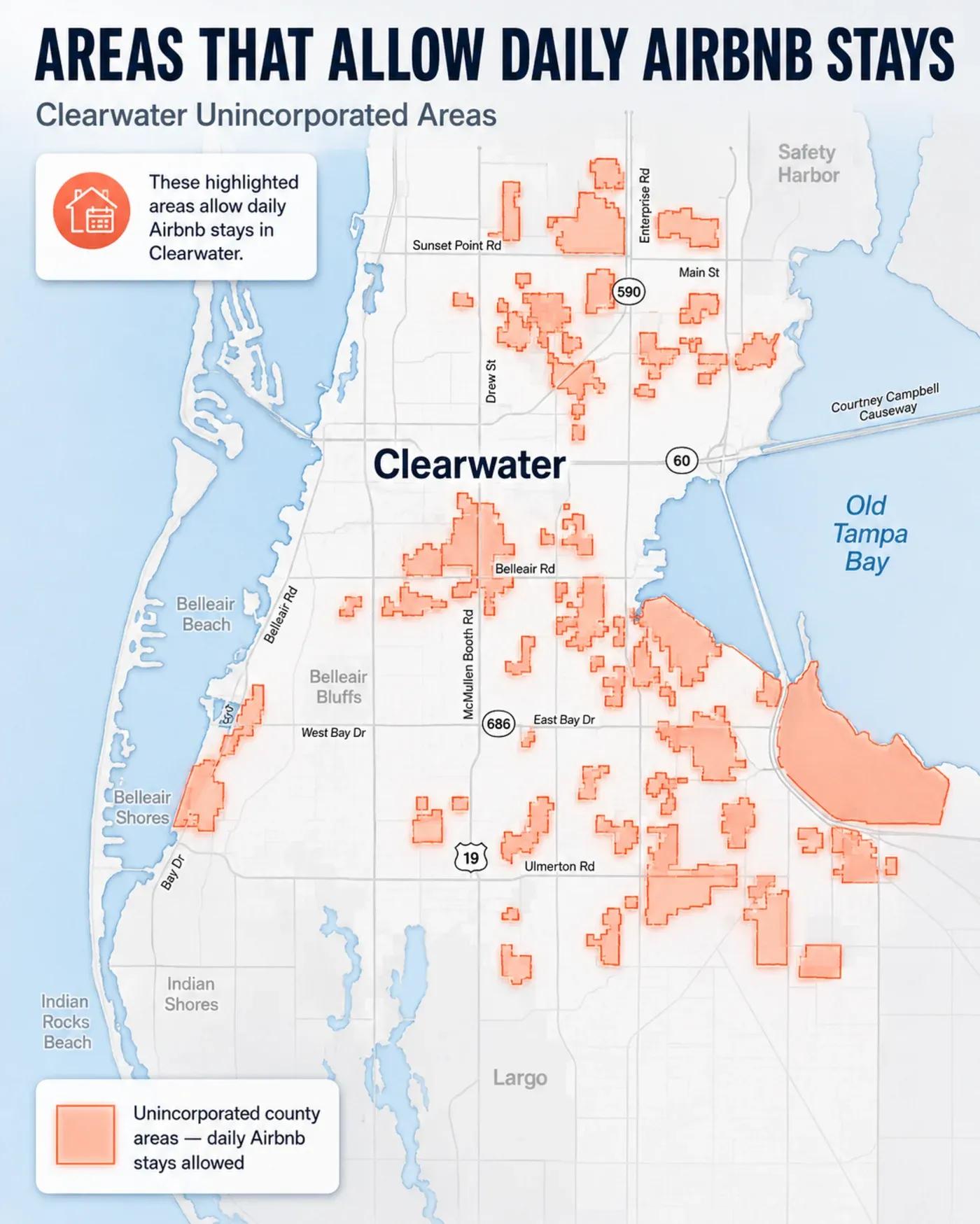
This map is a visual aid based on a source map. It is not legal proof that a specific parcel is unincorporated or eligible for daily rentals. Verify the exact parcel and jurisdiction with official county and city records before purchasing.
The county's zoning and land use page links a jurisdiction lookup. It also offers a zoning certification letter that states the zoning, land use and permitted uses of a parcel. For a purchase, that letter beats a screenshot.
What is the unincorporated occupancy limit? Under the county program, it is two guests per bedroom plus two in a common area, with a cap of 10. Guests of all ages count. The county also requires one off-street parking space for every three guests, rounded up. Last verified October 25, 2026.
An HOA that allows weekly rentals does not make it legal
No. The government has to allow the use, and the condo or HOA documents have to allow it too. An association can be stricter than the city. It can't make a use legal that the city or county does not allow.
Four paths to a legal Clearwater-area STR
I check four paths. Each one needs paper, not a listing remark.
A documented grandfathered rental
The use has to be on the city's record, and it can't have lapsed under Section 6-103. I want the city file before I trust the seller's story.
Tourist zoning or an approved lodging use
Resort attached dwellings in the T district may be rented for any term. Other property may have an approved overnight accommodations use. Condo-hotel product can also bring rental program rules and loan limits.
A condo or townhome where both layers agree
The public approval comes first. Then I read the declaration, bylaws, rental rules, minutes and any pending changes.
An unincorporated Pinellas property
This is the lane many buyers miss. The county requires a Certificate of Use and sets occupancy, parking and quiet hours.
How to check one address before you offer
Confirm the government, then the zoning and approved use, then the association rules, then the license and tax setup. My Pinellas STR zoning map walks through each step. If the city answer is unclear, ask for a written response tied to the parcel. A phone call is good for direction but weak proof for a large purchase.
If you plan to finance the purchase, read how to finance a short-term rental in Pinellas County. The loan can rule out some buildings before the rules do.
Frequently asked questions
What are the short-term rental rules in Clearwater?
On residentially zoned land inside the City of Clearwater, a home can't be rented for less than 31 days or one calendar month, whichever is less. The city's code compliance guide says owners there may advertise monthly rentals but not daily or weekly ones. It also says residential rentals need a Business Tax Receipt. Nightly stays need different zoning or an approved use.
Can I legally run a short-term rental or Airbnb in Clearwater Beach, Florida?
Only on some parcels: Clearwater Beach is part of the city, and the city's ADU page says short-term rentals are not permitted in residential zoning districts. A nightly rental there needs Tourist zoning, an approved lodging use, or a documented grandfathered use, so check the parcel before you offer.
Which waterfront buildings in Clearwater Beach are approved for Airbnb and short-term rentals?
I don't know of an official public list. The city's code compliance guide bars rentals under 31 days on residentially zoned property, so each building comes down to its zoning, any approved lodging use, and the condo rules. I check all three for every building. My Clearwater Beach guide shows how I screen them.
What does the 50% rule mean for buying a vacation rental home in Clearwater Beach?
Two 50 percent tests can apply. FEMA's FloodSmart site says a building is substantially damaged when restoring it would cost 50 percent or more of its market value before the damage, and the community makes that call. Clearwater's code has a separate 50 percent test for grandfathered uses, based on assessed value, covered above. For the flood side, read the Pinellas flood zone guide.
Can you run a short-term rental in unincorporated Pinellas near Clearwater?
Yes, with a county Certificate of Use. The Pinellas County STR program covers homes rented for less than 30 days, more than three times a year. Owners apply, pass an inspection and pay the fees, and occupancy is capped at 10 guests. Some homes with a Clearwater mailing address sit in unincorporated Pinellas, so confirm the jurisdiction first.
Do I need a city business tax receipt for a Clearwater rental?
Yes. The city's code compliance guide says a Business Tax Receipt is required for residential rentals under CDC 3-2301. The application needs a local contact with a working phone number and a street address, not a post office box, in Pinellas, Hillsborough, Pasco, Manatee or Sarasota County.
Send me a Clearwater address before you offer
Send the address, or the building and unit, and how you plan to rent it. I will come back with:
- Which government controls the parcel: the City of Clearwater or unincorporated Pinellas
- The stay rule that fits that zoning and use
- The records to ask the seller for, including any city nonconforming file
- The condo or HOA rental rules to read before your inspection period ends
Own a grandfathered Clearwater rental? Here is what a buyer will ask for: selling an Airbnb in Pinellas County.
Troy Nowak, Licensed Real Estate Broker, Mangrove Bay Realty (BK3436609)